
NCARB BY THE NUMBERS 2026
Recently, NCARB released its annual “By the Numbers.” Today, we introduce you to NCARB by the Numbers.
https://www.ncarb.org/nbtn2026
For perhaps a better understanding, you are encouraged to listen to the Practice of Architecture podcast — Inside the Data, NCARB by the Numbers, and the Future of Flexible Licensure
As stated on the its website, the 2026 edition of NCARB by the Numbers, this report is based on data collected by the National Council of Architectural Registration Boards (NCARB) during the 2025 calendar year, providing insight on the path to licensure. NCARB maintains a database on licensure candidates and Certificate holders. This allows us to track the progression of candidates as they move through the AXP, ARE, and beyond.
More specifically, the data shared is on the following topics:
- State of Licensure
- Pathways to Practice
- Demographics
- Building Toward Competency
- Examination
- Inside NCARB
- Jurisdictions
One of the first data points relates to the following:
The number of licensed architects grew in 2025—but the pool of candidates pursuing licensure fell slightly. Despite the 1% decrease in candidates working toward licensure, NCARB has still seen high levels of active candidates over the past several years. Meanwhile, the total number of U.S. architects recovered from last year’s drop and the number of reciprocal licenses dipped slightly, in keeping with the pattern NCARB has seen historically in license distribution.
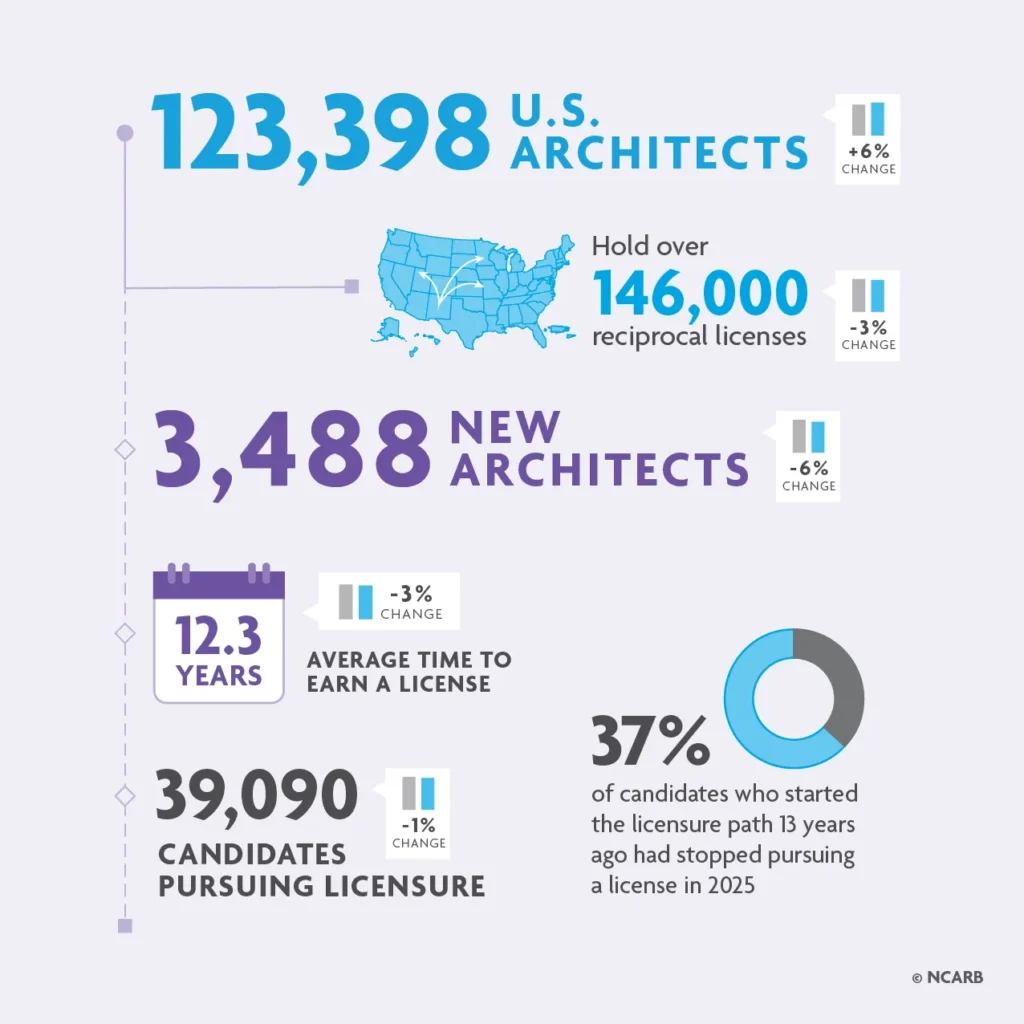
The number of newly licensed architects dropped by 6% (just over 200 individuals), but still aligned with the typical 9 – 10% of the active candidate pool. Those new architects completed the path to licensure faster than the previous year: On average, it took candidates 12.3 years to earn a license in 2025, approximately 4 months less than in 2024.
The number of U.S. architects rose by 6% in 2025, according to NCARB’s annual Survey of Architectural Registration Boards. This recovery from last year’s decline could be the result of changes in the way state licensing boards report residential versus reciprocal licenses; in addition, individuals who became inactive in 2024 may have returned to renew their license in 2025. However, NCARB continues to anticipate a decline in the number of U.S. architects in the coming years as baby boomers begin to filter out of the pool of architects. Architects who are over the age of 65 made up 14% of the total architect pool in 2025. As the oldest baby boomers begin to reach their 80s, the number of architects might fall over the next several years before evening out at a “new normal.”
Now, here are some of the details from NCARB by the Numbers; for complete details, access the full report.
Pathways to Practice: https://www.ncarb.org/nbtn2026/pathways-to-practice
Through Pathways to Practice, NCARB is working to ensure qualified applicants can enter the profession by creating an accessible yet equally rigorous licensure process. NCARB’s data shows that the current “single path” approach to the licensure process creates a variety of pinch points that can impact candidates based on a range of factors, including their career, education, and socio-economic background.
State of Licensure: https://www.ncarb.org/nbtn2026/state-of-licensure
Demographics: https://www.ncarb.org/nbtn2026/demographics
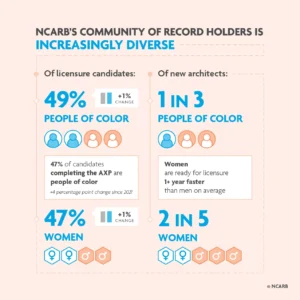
Over the past several years, NCARB has introduced several changes to improve accessibility within our programs, with the goal of ensuring that individuals of all backgrounds have a Pathway to Practice. Our data shows that these changes are having an impact. Greater diversity in the candidate population is beginning to make its way to the pool of licensed architects: In 2025, more than 1 in 5 architects identified as a person of color.
Building Competency: https://www.ncarb.org/nbtn2026/competency
The licensure process is designed to help candidates build up their ability to competently practice architecture—specifically in areas of practice that are tied to the public’s health, safety, and welfare.
Examination: https://www.ncarb.org/nbtn2026/examination
In 2025, NCARB saw the time to complete the exam fall to a record low. The average candidate who finished the ARE in 2025 took just 2 years—4 months faster than in 2024 and the lowest average completion time seen in the history of the computerized ARE. Plus, over 1,000 candidates who finished the exam in 2025 did so in 12 months or less.
Inside NCARB: https://www.ncarb.org/nbtn2026/inside-ncarb
Throughout the year, NCARB worked to support our growing community of licensing board members, architects, licensure candidates, volunteers, and more. We offer support to the 55 U.S. architectural licensing boards who make up NCARB’s members, encourage program alignment across the United States, and assist individuals seeking licensure as they navigate jurisdictional requirements.
Jurisdiction: https://www.ncarb.org/nbtn2026/jurisdictions
This section includes baseline comparisons for NCARB’s 55 Member Boards, which include all 50 states, the District of Columbia, Guam, the Northern Mariana Islands, Puerto Rico, and the U.S. Virgin Islands. Explore a 2025 snapshot of the jurisdiction’s licensure candidate activity, exam pass rate, number of architects, and reciprocity data.
You are encouraged to review NCARB by the Numbers to better understand the results of their survey.
Source: NCARB by the Numbers – https://www.ncarb.org/nbtn2026